I'm Always Busy And I Don't Do Numbers—Yet This Short Investing Course Made Money Make Sense

by Ida Aldana
Published on Jan 30, 2026
Have you ever had that one thing you've encountered so often—and for so long—that at some point, you were just too afraid to ask? Like 6-7.
Yeah. That's investing for me.
Growing up, anything that sounded even remotely like finance—stocks, the market, "investing"—made me internally scream. My brain would shut down the second someone said "stocks," or "GDP," or "dividends." They never really taught it in school, either. Instead, I was endlessly solving for x and the ETA of a moving train moving at a very specific speed.
So I surprised even myself when I signed up for a four-week Fundamentals of Investing certificate course at Accel Institute. I didn't do it because I suddenly wanted to become the thing I feared most (a finance bro in loafers and a puffer vest, thanks for asking), but because I was tired of being scared of money and hiding from it like a co-worker outside the office.
What's it like taking Fundamentals of Investing at Accel Institute?
My Investing 101 classes were held every Saturday in BGC, from 1 p.m. to 5 p.m. (Thank God because I can't imagine waking up early on a weekend after a loooong work week.) The sched was perfect, too, because I didn't have to rush on weekdays, and after a productive day in class, I could go around and shop, LOL!
There was a coffee and snack break in between each session and we all got detailed presentations and handouts. They even gave us notebooks and pens. TBH, it felt so legit that I half-expected a pop quiz at any moment.
The classes were taught by Carl Ng, a healthtech investor and startup advisor; Nichel Gaba, the Founder and CEO of PDAX (a Philippine platform for trading crypto); and Anthony De Guzman, the brains behind Accel Institute itself and a global market investor. In short: these aren't just people who talk about money—they actually do it, and somehow make it feel doable even if you've never thought about investing before.
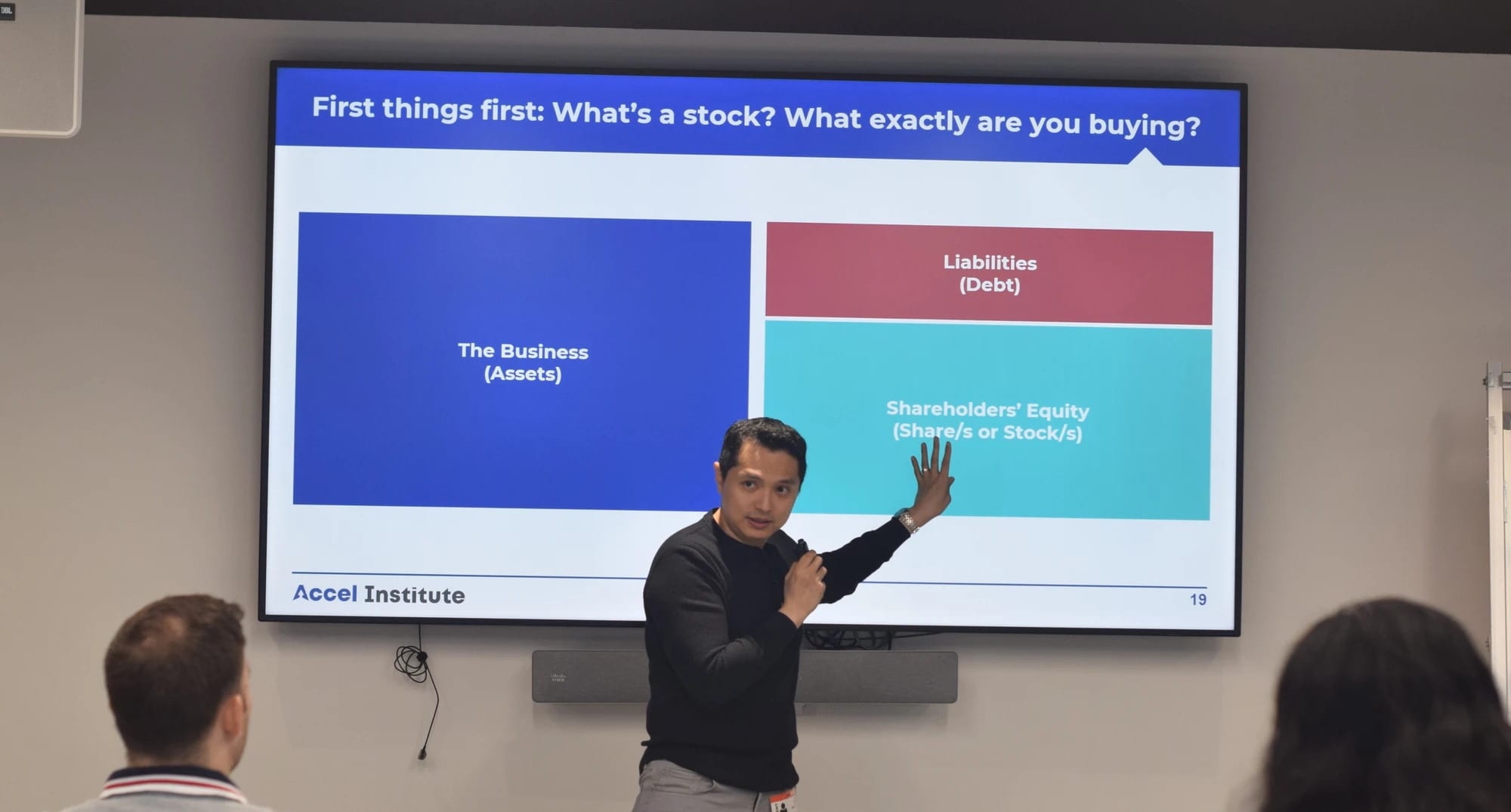
Over four sessions, we went through structured lessons that built on each other, focused on US-based stocks, and dove into frameworks and practical ways to think about money instead of drowning in buzzwords. Though to be fair, yes, crypto and the AI bubble were mentioned a couple of times. 😅
After class, students and lecturers headed to a nearby restaurant (usually a diff one per week) for socials with other cohorts—totally optional, but yes, there was food, drinks, and more business talk if you were up for it. It made learning feel less intimidating and, honestly, more human.
Here's what stuck with me—and why I'll probably never see my money the same way again:
Everyone's on their own money journey.
On the first day, we all had to introduce ourselves: a fresh grad, a couple of young professionals like me, entrepreneurs, career shifters, even retirees. It was a relatively small cohort (not more than 10 people) but with a breadth of different experiences and know-how. Some had MP2 Savings or played around with stocks, others had no experience at all. Everyone came in with different goals, anxieties, and starting points.
It was eye-opening to realize that money management doesn't discriminate. Your age, your career stage, your "adulting" level—none of it matters. Everyone's figuring it out in their own way, and that's okay. You can get started when you want to and when you feel ready.

3 Types Of Investments To Look Into If You're Only A Beginner
Investment consultant and financial coach Yani Moya shares what you should know.
READ MOREThink of your money in three buckets: protect, grow, aspire.
This was the first real "aha" moment for me. (Granted, it did happen on the first day of class.) And true enough, Anthony says one of the things that surprises students the most is that "a simple framework for investing can be so insightful and powerful, yet easy to apply." He adds, "It's a practical approach, whether you're talking about investing small or large amounts."
In the course, they teach the Wealth Allocation Framework, which is based on the one described by financial thinker Ashvin Chhabra in The Aspirational Investor. It breaks your money into three buckets:
Safety – protecting your essentials, like your savings in your traditional bank and property (houses, condos, etc.) you already own
Market – growing your money through investments, like stocks
Aspirational – going after your big goals, like starting a business, funding a creative project, or other high-risk, high-reward ventures
Anthony shares that students don't expect how different their perception of risk is from the reality of their portfolio—some think they're conservative but are actually overweight in high-risk assets, while others assume they're aggressive but have been playing it too safe. "The course has helped students (and me!) practically re-allocate our hard-earned money to help us achieve our respective financial goals," he says.
All the lessons pretty much followed this main idea. Visualizing everything like this made it feel waaaay less scary. Suddenly, I could see exactly where I stood and what I actually cared about.

Get To Know The Pros (And Cons) Of Owning A Credit Card
Make your finances work for you, and not against you.
READ MOREThe stock market is not a blind box.
Sure, you'd be happy with whichever anik-anik design you'll get when you unbox it. But in investing, you can't just throw money at something you can't even see and hope for the best. Invest in what you understand—or can actually see and believe in IRL.
Personally, I stay updated on trends in fashion, beauty, wellness, and tech—partly because of my job as an editor, partly because they're my interests. I know when an It Girl bag is trending, when a brand is getting canceled, when a weight-loss drug is making waves or when a new phone drops with a selfie-perfect front cam. All those things affect stock prices. That context helps me decide what I'd actually want to put my money in.
I also figured out what I don't want to invest in. If something goes against your values—ethically, environmentally, or just personally—it's okay to skip it. Not to be morbid about it, but at the time I took the class, my dad had just passed away from cancer, so you already know what I'm never going to invest in. 🤷♀️
Your investments aren't just about making money; they can be aligned with the stuff you actually care about, too. Having that personal context turned investing from some abstract, scary world into something I could relate to—and actually feel confident exploring.

Don't let anyone tell you what to invest in.
One thing they kept repeating: they're teaching us how to think, not what to think. And honestly, at the end of the day, it's still up to you if you'll take them up on it, lol.
When I ask my friends when I need advice on which pair of shoes to get, that's shopaholics enabling each other. But stocks are different. No one should tell you exactly which stock to buy. Not your friend, not a Reddit thread, not some guy online who might have ulterior motives. The goal is to make your own decisions, not copy someone else blindly—especially when your hard-earned money is on the line.
Case in point: one of my classmates shared a story about losing money on stock picks from someone they subscribed to. A real-life reminder that even seemingly "expert" advice can go sideways—and that informed, independent choices matter more than hot tips.
That's actually one of the reasons that motivated Anthony to start this course. "Many of those who do invest were often misguided by the hype they see online and on social media. With so much information online, it's become very hard to distinguish good vs. bad ideas." That's why it became his advocacy "to teach investing in a way that's both fundamentally sound, as well as practically applicable, even for non-finance enthusiasts."
Build a system you can actually stick to.
Like many other things in adulting (e.g. working out, doing skincare, going to therapy, etc.): consistency beats perfection. You don't have to check the market daily. You don't have to invest weekly if that stresses you out. Pick a rhythm that works for your life. Even small steps—once a month, automated transfers, or low-maintenance stocks—matter more than doing everything "right" according to some guru. It's about creating a system you can actually live with.

What Is The FIRE Method, And How Does It Actually Allow You To Retire Early?
It's all about investing in your early retirement.
READ MOREIt takes time.
Doesn't everything? This is probably the first thing they'll tell you about investing because interest compounds. (See? I learned something!) But I also mean it in a sense that it takes time to learn.
Anthony says one misconception he hopes students leave behind is that investing is the job of financial advisors. "It's your money, so you should learn how to manage and grow it." he explains. Sure, you can still use advisors—but too often, their priority is selling products or protecting their reputation, not actually looking out for your financial interests.
He shares a story of a friend whose wealth manager advised selling his entire stock portfolio at the bottom of the 2025 downturn—not because the friend couldn't take the risk, but because the bank didn't want the reputational fallout. "My friend is business-savvy, but believed he was too busy to learn investing on his own, so instead he outsourced it to financial advisors and wealth managers," Anthpny says. "That situation could've been prevented if he learned even just the fundamentals of investing, and felt sufficiently knowledgeable and empowered to decide for himself. I told him that already, but I hope he's also reading this!"
Investing (and learning about money) isn't instant gratification. Just like a viral gay hockey show right now, it's a slooooow burn. You're not going to figure everything out in a weekend, a month, or even four weeks. You're not going to earn millions within that timeframe either (unless you're talking about flood control projects).
The important part is just to start, be consistent, and let your knowledge—and your money—grow over time. Patience isn't just a virtue here; it's basically your secret weapon.

How do you enroll at Accel Institute?
You can learn more about Fundamentals of Investing and Accel Institute's other courses on their website.
Aside from investing, they also offer classes on Fundamentals of Business, Leadership & People Management, Fundraising for Business, Strategic Execution & Communication, and Data and AI Fundamentals for Businesspeople, among others. Courses typically run on set dates, around three to four times a year.
Each course runs for four sessions and is priced at P25,000.

5 Questions You Need To Ask Yourself Before Applying For Graduate School
Because the "student forever" fantasy comes with fine print.
READ MOREIda Aldana is the Executive Editor of Cosmopolitan Philippines. A lifestyle journalist and self-proclaimed pop culture curator, she moves through life always half-writing, turning mundane moments into meaningful stories. She holds an M.S. in Publishing: Digital and Print Media from New York University—and a lifetime degree in memes.