Big Romantic Gestures Are Fun—But Now I Know Real Love Is In The Little Things

Published on Feb 14, 2026
Valentine's Day has a way of making romance feel like it needs to be impressive. Not just meaningful, but memorable—preferably in a way that photographs well and makes for a great IG Story later on. And while I've always loved the idea of big romantic gestures (I'm still deeply susceptible to a well-executed romantic moment, because I did, after all, grow up on 2000s rom-coms), I've started to notice that the gestures that stay with me the longest are rarely the most elaborate ones.
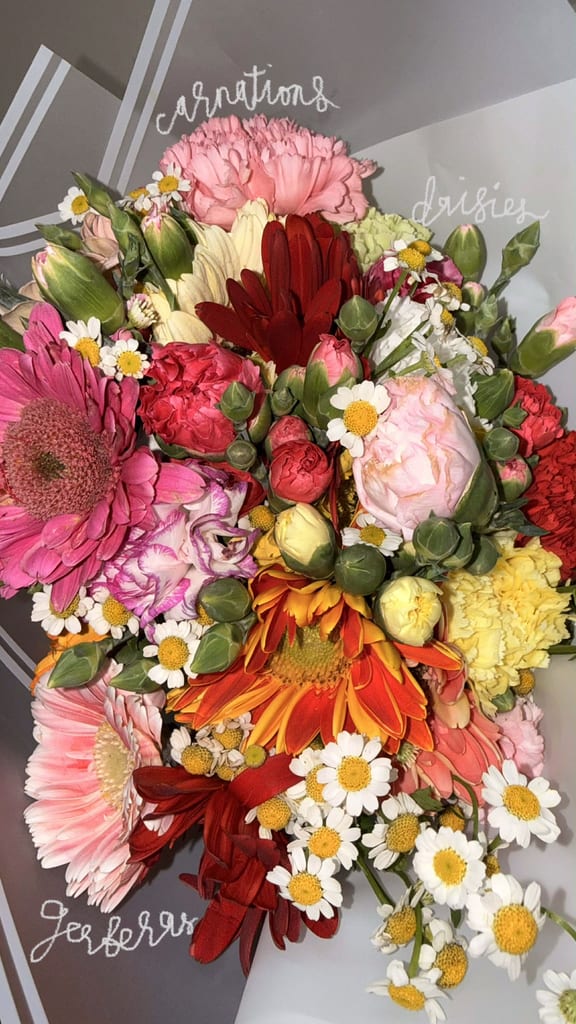
This V-Day, for example, my boyfriend still gave me flowers, as is his yearly tradition—but instead of ordering a pre-arranged bouquet like he normally would, he picked out individual stems he knew I'd like, arranged them himself(!), and had them delivered to me. It was such a small shift from tradition, but it felt so much more intimate and special, knowing he did everything on his own.
And the more I sat with that feeling, the more I realized something that feels radical in today's very visible, very curated-for-social-media romantic landscape:
Why we've learned to associate love with "bigger = better"
Romance has become easy to decode as the years go by. We recognize it instantly because we've been taught its visual cues: scale and shareability. The bigger the flowers, the harder the reservation is to secure, and the more elaborate the reveal, the stronger the love is assumed to be.
Valentine's Day didn't really create this idea, but it certainly amplifies it. The holiday compresses our expectations into a single date, encouraging us to believe that one romantic, sweeping gesture will prove all our beliefs about love right. It feels "successful" when it translates well to other people and how many likes it may get, not necessarily when it reflects what your partner actually values and knows about you.
However, the problem with that logic is that relationships aren't supposed to be built in front of an audience. They depend on how two people move through those dreary and mundane Mondays, how conflict is handled, how support shows up when life feels more stressful than usual, and how attention is sustained after the initial high fades. When romance is defined by scale, it becomes harder to recognize the forms of care that keep a relationship steady in the background.
To be loved is to be known
What made this year's bouquet feel meaningful was not the extra effort involved. It was the level of familiarity behind it.
He knew which flowers I looked at longingly whenever we passed by shops. He knew the colors I consistently like. He knew that I prefer arrangements that feel quirky and less structured. None of that information exists unless you've been watching someone long enough—and carefully enough—for patterns to form.
That's why the phrase keeps circling in my head lately: To be loved is to be known. It is being understood in the ways that shape your everyday life, not just in the stories you tell about yourself.
Being known takes time. It takes curiosity that doesn't disappear after the early stages of dating. It requires noticing how someone reacts to stress, what comforts them, what drains them, and what makes them feel more like themselves. When that knowledge is translated into action, even in the smallest of ways, it changes how care feels inside a relationship.
Why the "ordinary" parts of love are actually the good stuff
Most of the moments that make me feel genuinely cared for are not especially romantic in the traditional sense. They are practical, emotional, and sometimes, inconvenient.
It looks like being picked up from work whenever he can, simply so I don't have to deal with a long commute on a day that already feels heavy. It looks like him listening when I need to vent about something, without interrupting me with a solution I didn't ask for. It looks like him finding little pockets of time to see me, even when his schedule is already full. It also looks like the everyday tradition of calling before bedtime, just because it makes the day feel more complete. (If you can't already tell, I'm a Taurus, which means I'm a sucker for consistency and steadiness. ♉️)
These gestures do not stand out as impressive—hell, they won't even go viral. However, they do stand out as informed choices. They make daily life easier. They reduce friction. They create a sense of being supported without needing to ask for it explicitly. Over time, that kind of attentiveness builds a deeper form of closeness than any single carefully planned date.
Consistency might be the most underrated love language
When someone shows up dependably and consistently, you stop scanning the relationship for evidence of effort. You stop doing small mental check-ins after every interaction, wondering whether you're asking for too much or expecting too little. Care becomes something that doesn't feel foreign to you, rather than something you wait for.
Consistency also reveals how someone values you when there is nothing to celebrate, announce, or recover from. It shows up during regular weeks, stressful seasons, and unremarkable days, when attention is harder to prioritize. Over time, that steady presence becomes the foundation for trust.
What happens after the flowers wilt is much more important
Grand gestures make beautiful memories. But memories are not what sustain a relationship over time. What keeps love steady is a long pattern of small, intentional choices: to pay attention, to listen carefully, to remain emotionally available, and to always make room for each other even when life becomes crowded and distracting.
The flowers I received this year will eventually wilt. That part is unavoidable. (Though I've already picked out a few blooms to immortalize in my journal—again, something he knew I'd do.) What stays with me is the feeling behind them—the sense of being noticed in a very specific, personal, and intimate way.
In the end, love is less about how well it can be presented to other people and much more about how accurately it understands the person it's meant for.


5 Expert Tips For Happy, Long-Term Relationships
Here's how the happiest couples stay happy for a lifetime.
READ HERECheska is Cosmo's Lifestyle Editor. She loves hoarding blushes, oversharing in drafts, and pretending impulse buys are "for work." Follow her on IG: @cheskasntg